

Accountability, Consequences, and the Case for Trustworthy ".gov.ng" Domains- DIID Dialogues.
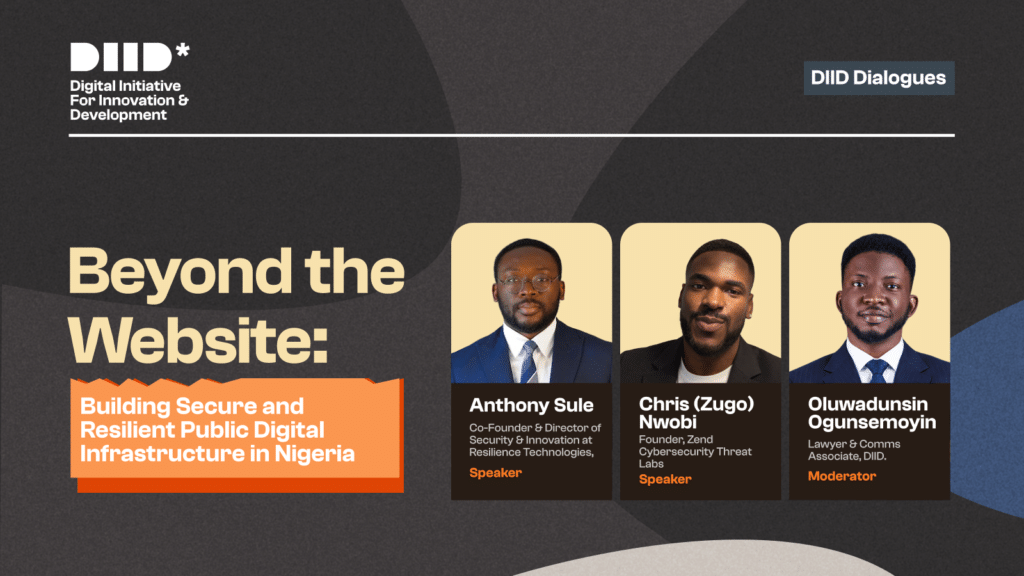
On Tuesday, September 22, 2026, we hosted another edition of DIID Dialogues on something you may have noticed in the news without quite clocking how big it is: gambling, casino, and pornographic content showing up on official Nigerian government websites.
We were joined by Chris Nwobi, founder of ZEND Cybersecurity Threat Intelligence Labs, and Anthony Sule, co-founder and Director of Security and Innovation at Resilience Technologies.
Here’s the backdrop. As far back as March 2026, the Foundation for Investigative Journalism reported that several .gov.ng subdomains were hosting gambling, crypto, and casino content, not stray ads slipping through, but actually hosted there, on sites including the Office of the Head of the Civil Service of the Federation. Chris picked up the thread soon after, almost by accident, while mapping what government cybersecurity actually looks like for a separate project. He found one compromised site, then another, then another, and by the time he was done tracing it, the pattern stretched across more than 20 African countries, all linked to an Indonesian gambling syndicate exploiting government infrastructure for search visibility. He reported it to Nigeria’s Minister of Communications, Dr. Bosun Tijani, and pages came down, but more kept surfacing, as recently as three weeks before this webinar.
That’s the question we sat down to answer: what happens when vulnerabilities like these get exploited, and what would it actually take to make sure .gov.ng domains are continually trustworthy?
Why government sites are such an easy target
Government domains carry high trust and a high ranking on Google, and that’s exactly what bad actors are exploiting. The same authority that should make a .gov.ng site safe is what makes it valuable to hijack.
Here’s what Chris and Anthony told us should happen next.
Give every government website a named owner
Chris’s clearest recommendation was the simplest one. Every government website needs a real, reachable security contact. When he first found these compromised pages, he had nowhere to send the report, because most agencies had no security function to speak of. “If there’s no ownership, stuff like this will keep on happening,” he said. Two years after a site launches, it’s common for an agency to have lost track of who even built it.
Build one trusted, verified list
Anthony pushed further: centralise it. Every agency and state government should submit its site to NITDA for proper security assessment and penetration testing, with only vetted sites carrying an official government seal, something the public can actually check. Right now, anyone can copy a government logo and stand up a convincing fake. He pointed to a recent scam site impersonating a road traffic agency to collect fraudulent payments. Without a verified list, there’s no way for an ordinary Nigerian to tell a real site from a fake one.
Treat this as a continental problem
When Chris traced the pattern, it didn’t stop at Nigeria’s border. The same syndicate had done the same across more than 20 African countries, and when he reached out to counterparts in Kenya and Ghana, he heard strikingly similar stories. His recommendation echoed something close to home for us: Africa needs a collective response here, not a fragmented, country-by-country patchwork.
Let researchers help, within real boundaries
Anthony drew a firm legal line. Independent researchers can’t test a live government system without authorisation, full stop. What they can do, and what Chris actually did, is open-source intelligence: publicly available searching that flags spoofed or malicious sites without ever touching a system’s defences. His recommendation was for more open bug bounty and threat research programs, so researchers have a legitimate channel to work through instead of an ambiguous one.
Make inaction expensive
Every recommendation in this conversation circled back to one word: consequence. Anthony compared this directly to the private sector, where a breach at a fintech like Paystack means real, immediate financial and reputational loss, which is exactly why bug bounty programs exist there. Government agencies rarely feel that same pressure. Nigeria’s Data Protection Regulation technically requires disclosure of a data breach within 72 hours and technically allows for fines, but Anthony noted those fines are small enough, relative to a large institution’s budget, to change little in practice. Chris pointed to the US government’s HackerOne program as a working model worth studying.
Stay in the loop
If you would like to connect, or stay updated on the events, policies and laws shaping Africa’s tech future, then subscribe to our newsletter and follow DIID on social media for updates on our next Dialogue